

What Animals Lived During The Oligocene Epoch
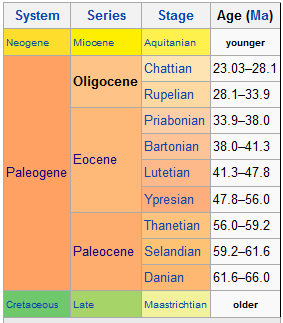
The Oligocene is a geologic epoch of the Paleogene period and extends from about 33.ix million to 23 million years before the present (33.9±0.1 to 23.03±0.05 Ma). As with other older geologic periods, the rock beds that define the period are well identified simply the exact dates of the start and end of the period are slightly uncertain. The name Oligocene comes from the Greek ὀλίγος (oligos, few) and καινός (kainos, new), and refers to the sparsity of additional modern mammalian species of fauna after a burst of evolution during the Eocene. The Oligocene is preceded by the Eocene epoch and is followed past the Miocene epoch. The Oligocene is the third and final epoch of the Paleogene catamenia.
The Oligocene is often considered an important time of transition, a link between the archaic world of the tropical Eocene and the more modernistic ecosystems of the Miocene. Major changes during the Oligocene included a global expansion of grasslands, and a regression of tropical broad leafage forests to the equatorial chugalug.
The beginning of the Oligocene is marked by a notable extinction consequence called the Grande Coupure; information technology featured the replacement of European animate being with Asian fauna, except for the owned rodent and marsupial families. By contrast, the Oligocene–Miocene boundary is not set at an easily identified worldwide outcome only rather at regional boundaries between the warmer tardily Oligocene and the relatively libation Miocene.
Subdivisions
Oligocene faunal stages from youngest to oldest are:
Chattian or Late Oligocene (28.1 – 23.03 mya)
Rupelian or Early Oligocene (33.nine – 28.i mya)
Climate
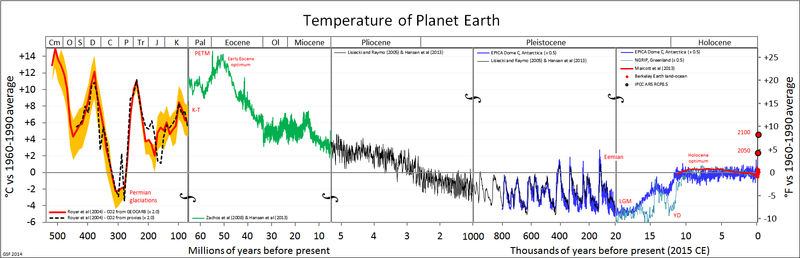
The Paleogene menstruation general temperature decline is interrupted by an Oligocene seven million twelvemonth stepwise climate change. A deeper 8.2 °C, 400,000 year temperature low leads the 2 °C, vii million year stepwise climate change 33.5 Ma (Million years agone). The stepwise climate change began 32.5Ma and lasted through to 25.5Ma, as depicted in the PaleoTemps nautical chart. The Oligocene climate change was a global increase in ice volume and a 55 M (181 feet) decrease in sea level (35.7-33.5 Ma) with a closely related (25.5–32.five Ma) temperature depression. The vii one thousand thousand year depression abruptly terminated inside one–two meg years of the La Garita Caldera eruption at 28-26 Ma. A deep 400,000 yr glaciated Oligocene Miocene boundary consequence is recorded at McMurdo Sound and King George Island.
Paleogeography
During this menstruation, the continents continued to drift toward their nowadays positions. Antarctica became more isolated and finally developed an ice cap.(Haines)
Mountain building in western North America connected, and the Alps started to rise in Europe as the African plate continued to push due north into the Eurasian plate, isolating the remnants of the Tethys Bounding main. A brief marine incursion marks the early Oligocene in Europe. Marine fossils from the Oligocene are rare in N America. In that location appears to accept been a country bridge in the early on Oligocene between North America and Europe, since the faunas of the two regions are very similar. Sometime during the Oligocene, South America was finally detached from Antarctica and drifted n towards North America. It also allowed the Antarctic Circumpolar Current to menses, quickly cooling the Antarctic continent.
Flora
Angiosperms continued their expansion throughout the globe as tropical and sub-tropical forests were replaced by temperate deciduous forests. Open plains and deserts became more than common and grasses expanded from their water-bank habitat in the Eocene moving out into open tracts. However, even at the end of the period grass was not quite common enough for modern savannas.(Haines)
In North America, subtropical species dominated with cashews and lychee trees present, and temperate trees such equally roses, beeches, and pines were mutual. The legumes spread, while sedges, bulrushes, and ferns connected their ascent.
Animate being
Important Oligocene state fauna are found on all continents at this fourth dimension. Even more open landscapes immune animals to abound to larger sizes than they had earlier in the Paleogene. Marine faunas became fairly mod, as did terrestrial vertebrate fauna on the northern continents. This was probably more equally a result of older forms dying out than as a effect of more modern forms evolving. Many groups, such every bit horses, entelodonts, rhinoceroses, oreodonts, and camels, became more than able to run during this time, adapting to the plains that were spreading as the Eocene rainforests receded. The starting time felid, Proailurus, originated in Asia during the late Oligocene and spread to Europe.
Southward America was isolated from the other continents and evolved a quite singled-out fauna during the Oligocene. The South American continent became home to strange animals such equally pyrotheres and astrapotheres, as well as litopterns and notoungulates. Sebecosuchian crocodiles, terror birds, and carnivorous marsupials, like the borhyaenids remained the dominant predators. Brontotheres died out in the Earliest Oligocene, and creodonts died out outside Africa and the Middle E at the end of the period. Multituberculates, an ancient lineage of archaic mammals, also went extinct in the Oligocene. The Oligocene was dwelling house to a wide variety of strange mammals. A good example of this would be in the White River Badlands of North America, which were formerly a semi-arid prairie dwelling to many different types of owned mammals, including entelodonts like Archaeotherium, camels (such every bit Poebrotherium), running rhinos, iii-toed horses (such as Mesohippus), nimravids, protoceratids, and early dogs similar Hesperocyon. Oreodonts, an endemic American group, were very diverse during this time. In Asia during the Oligocene, a group of running rhinos gave ascent to the indricotheres, like Indricotherium, which were the largest state mammals always to walk the World.
The marine animals of Oligocene oceans resembled today's fauna, such as the bivalves. Calcareous cirratulids appeared in the Oligocene. The fossil record of marine mammals is a niggling spotty during this time, and non as well known as the Eocene or Miocene, just some fossils take been found. The baleen and toothed cetaceans, or whales, had just appeared, and their ancestors, the archaeocete cetaceans began to subtract in variety due to their lack of echolocation, which was very useful every bit the water became colder and cloudier. Other factors to their decline could include climate changes and competition with today's modern cetaceans and the carcharhinid sharks, which too appeared in this epoch. Early desmostylians, like Behemotops, are known from the Oligocene. Pinnipeds probably appeared nearly the end of the epoch from a comport-like or otter-like ancestor.
Oceans
The Oligocene sees the beginnings of modern ocean apportionment, with tectonic shifts causing the opening and closing of body of water gateways. Cooling of the oceans had already commenced by the Eocene/Oligocene boundary, and they continued to cool as the Oligocene progressed. The formation of permanent Antarctic ice sheets during the early on Oligocene and possible glacial activity in the Chill may have influenced this oceanic cooling, though the extent of this influence is however a affair of some pregnant dispute.
The effects of oceanic gateways on circulation
The opening and closing of ocean gateways: the opening of the Drake Passage; the opening of the Tasmanian Gateway and the endmost of the Tethys seaway; forth with the terminal formation of the Greenland–Iceland–Faroes sill; played vital parts in reshaping oceanic currents during the Oligocene. As the continents shifted to a more modern configuration, so too did ocean circulation.
The Drake Passage
The Drake Passage is located between Southward America and Antarctica. Once the Tasmanian Gateway between Australia and Antarctica opened, all that kept Antarctica from being completely isolated past the Southern ocean was its connection to S America. As the South American continent moved northward, the Drake Passage opened and enabled the formation of the Antarctic Circumpolar Electric current (ACC), which would have kept the cold waters of Antarctica circulating around that continent and strengthened the formation of Antarctic Bottom Water (ABW). With the cold h2o concentrated effectually Antarctica, sea surface temperatures and, consequently, continental temperatures would have dropped. The onset of Antarctic glaciation occurred during the early Oligocene, and the effect of the Drake Passage opening on this glaciation has been the subject area of much research. However, some controversy still exists every bit to the exact timing of the passage opening, whether it occurred at the start of the Oligocene or nearer the end. Still, many theories concur that at the Eocene/Oligocene (E/O) boundary, a still shallow flow existed betwixt South America and Antarctica, permitting the start of an Antarctic Circumpolar Current.
Stemming from the upshot of when the opening of the Drake Passage took identify, is the dispute over how keen of an influence the opening of the Drake Passage had on the global climate. While early researchers ended that the advent of the ACC was highly important, perhaps even the trigger, for Antarctic glaciation and subsequent global cooling, other studies accept suggested that the δ18O signature is too strong for glaciation to exist the main trigger for cooling. Through study of Pacific ocean sediments, other researchers take shown that the transition from warm Eocene ocean temperatures to absurd Oligocene ocean temperatures took simply 300,000 years, which strongly implies that feedbacks and factors other than the ACC were integral to the rapid cooling.
The Late Oligocene opening of the Drake Passage
The latest hypothesized time for the opening of the Drake Passage is during the early Miocene. Despite the shallow catamenia between South America and Antarctica, there was non plenty of a deep water opening to allow for pregnant flow to create a true Antarctic Circumpolar Current. If the opening occurred as late every bit hypothesized, then the Antarctic Circumpolar Current could not have had much of an effect on early Oligocene cooling, equally it would not take existed.
The Early Oligocene opening of the Drake Passage
The earliest hypothesized time for the opening of the Drake Passage is around 30 Ma. One of the possible bug with this timing was the continental debris cluttering upwards the seaway between the two plates in question. This debris, forth with what is known as the Shackleton Fracture Zone, has been shown in a recent study to be fairly young, only about 8 meg years old. The written report concludes that the Drake Passage would be gratuitous to permit significant deep h2o flow by effectually 31 Ma. This would have facilitated an earlier onset of the Antarctic Circumpolar Electric current.
Currently, an opening of the Drake Passage during the Early on Oligocene is favored.
The opening of the Tasman Gateway
The other major oceanic gateway opening during this time was the Tasman, or Tasmanian, depending on the newspaper, gateway between Australia and Antarctica. The fourth dimension frame for this opening is less disputed than the Drake Passage and is largely considered to have occurred around 34 Ma. As the gateway widened, the Antarctic Circumpolar Electric current strengthened.
The Tethys Seaway closing
Though the Tethys was not a gateway, but rather a sea in its own right. Its closing during the Oligocene had meaning impact on both ocean circulation and climate. The collisions of the African plate with the European plate and of the Indian subcontinent with the Asian plate, cut off the Tethys seaway that had provided a low-latitude ocean circulation. The closure of Tethys congenital some new mountains (the Zagros range) and drew down more carbon dioxide from the atmosphere, contributing to global cooling.
Greenland–Iceland–Faroes
The gradual separation of the dodder of continental crust and the deepening of tectonic sill in the Northward Atlantic that would become Greenland, Republic of iceland, and the Faroe Islands helped to increment the deep water flow in that area. More than information about the evolution of North Atlantic Deep Water will be given a few sections down.
Ocean cooling
Evidence for bounding main-broad cooling during the Oligocene exists by and large in isotopic proxies. Patterns of extinction and patterns of species migration can also be studied to gain insight into ocean conditions. For a while, it was thought that the glaciation of Antarctica may take significantly contributed to the cooling of the bounding main, however, contempo evidence tends to deny this.
Deep h2o
Isotopic evidence suggests that during the early Oligocene, the main source of deep water was the N Pacific and the Southern Bounding main. As the Greenland-Iceland-Faroe sill deepened and thereby connected the Norwegian–Greenland sea with the Atlantic Ocean, the deep h2o of the Northward Atlantic began to come up into play as well. Computer models suggest that once this occurred, a more than modernistic in appearance thermo-haline circulation started.
North Atlantic deep water
Testify for the early Oligocene onset of chilled North Atlantic deep water lies in the beginnings of sediment drift deposition in the Due north Atlantic, such as the Feni and Southeast Faroe drifts
South Ocean deep water
The chilling of the South Ocean deep water began in earnest once the Tasmanian Gateway and the Drake Passage opened fully. Regardless of the time at which the opening of the Drake Passage occurred, the issue on the cooling of the Southern Body of water would have been the same.
Impact events
Recorded extraterrestrial impacts:
- Nunavut, Canada (23 Ma, crater 24 km (15 mi) diameter,)
Supervolcanic explosions
La Garita Caldera (28 through 26 million years ago, VEI=9.2) The above story is based on materials provided by Wikipedia
Source: https://www.geologypage.com/2014/04/oligocene-epoch.html
Posted by: eppersonourthe46.blogspot.com
0 Response to "What Animals Lived During The Oligocene Epoch"
Post a Comment